
Many readers assume that indie authors choose self-publishing because they were not good enough to secure a traditional publishing deal. That assumption could not be further from the truth. For many of us, self-publishing is not a fallback plan. It is a strategic, informed decision. For me, it was a choice I made intentionally and one I am proud to stand behind.
When I first started looking into publishing my books, I was just stepping out of the fanfiction stage and ready to take my writing seriously. I had spent years writing on platforms like Fanfiction.net, along with apps such as Chapters Interactive, Wattpad, and Inkitt. By then, I had built a growing readership and felt it was time to see what could happen if I treated writing as a professional pursuit instead of a hobby.
After more than a year of writing, editing, querying, and waiting, my first traditionally published book, Dreamer, was released through a small press called Cayelle Publishing under their Celest imprint. They have since closed their doors, but that experience played a major role in shaping how I view the publishing industry.
What I learned while working with a publisher was eye-opening. Despite being traditionally published, the majority of the responsibility still rested on me. Marketing, promotion, and audience growth were largely my job, and it was exhausting. Before becoming an author, I worked as a talent agent, and much of what I was seeing felt familiar. Talent agents and literary agents operate in very similar ways, especially when negotiating with publishers and managing contracts. It is truly two sides of the same coin.
Eventually, I reached a point where I realized I could implement much of what I already knew about the industry on my own. I understood branding, promotion, and contract structures. I knew how publishers operated. And once that realization set in, the idea of taking control of my own work became impossible to ignore. So I did.
I began studying the book publishing industry more closely and preparing my books for self-publishing. This was not entirely new territory for me. I had prior experience in magazine publishing as the former owner of LUX Local Magazine, an international fashion and lifestyle publication I ran for several years while working as a talent agent. I also wrote as a correspondent for multiple fashion and beauty magazines. Publishing, in many forms, was already familiar ground.
The deeper I went, the clearer it became. Self-publishing gave me the ability to release books faster, build my author brand with intention, and operate on my own terms. I could avoid restrictive contracts, eliminate long wait times, and make decisions that aligned with my career goals instead of someone else’s timeline. For the first time, I was also able to fully use my graphic design and publishing skills, rather than handing that control over to someone else.
The biggest realization was that I did not have to give anything up to do this. I could still operate the way trade publishers do, using the same professional distribution channels and industry standards that allow for long-term growth. Having my books available in libraries and brick-and-mortar stores has always mattered to me, and self-publishing did not require me to sacrifice that goal. It simply required knowing how to get there.
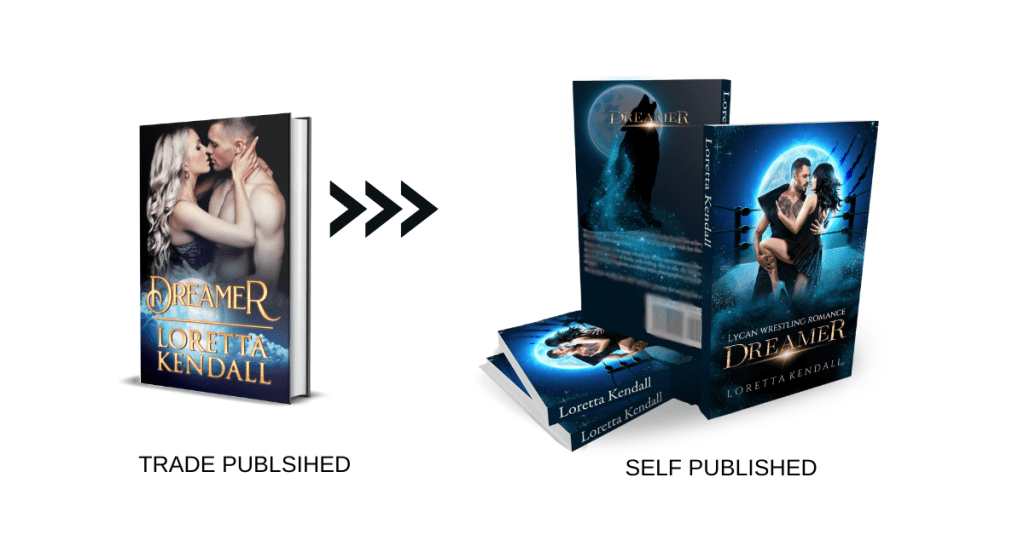
Now that I have my book, Dreamer, back from the publisher and have fully transitioned to self-publishing, my goals feel closer than ever to becoming reality. That became especially clear when I compared my first trade-published edition to the new self-published version. From the cover design to the interior layout, the difference is undeniable. I am happier with the final product and grateful for the experience that taught me how to do it better.
That doesn’t mean it was easy. Indie publishing requires extensive research, planning, and consistent effort. I understand why some readers assume indie authors are lazy or not skilled enough, but the reality is it comes down to choice. Very few authors land traditional trade deals, especially in a market that is now oversaturated due to how easy submissions have become. Securing an agent and publisher can take years, with no guarantees.
For me, indie publishing was not the shortcut. It was the smartest path forward. Not because I couldn’t succeed traditionally, but because I chose to build something entirely my own.
 Loretta Kendall