App writing is a MLM pyramid scheme…. There I said it!
The very definition of a pyramid scheme is a business model that recruits members with the promise of payments for enrolling others into the scheme. The highest man in the pyramid makes the most money. MLM (Multi Level Marketing) companies like Avon run on the same business plan. They have low level sales people to earn minimal amounts while the company keeps majority profits for the goods they sell.
Sound familiar? If you’re an author in the serial reading app community, it might.
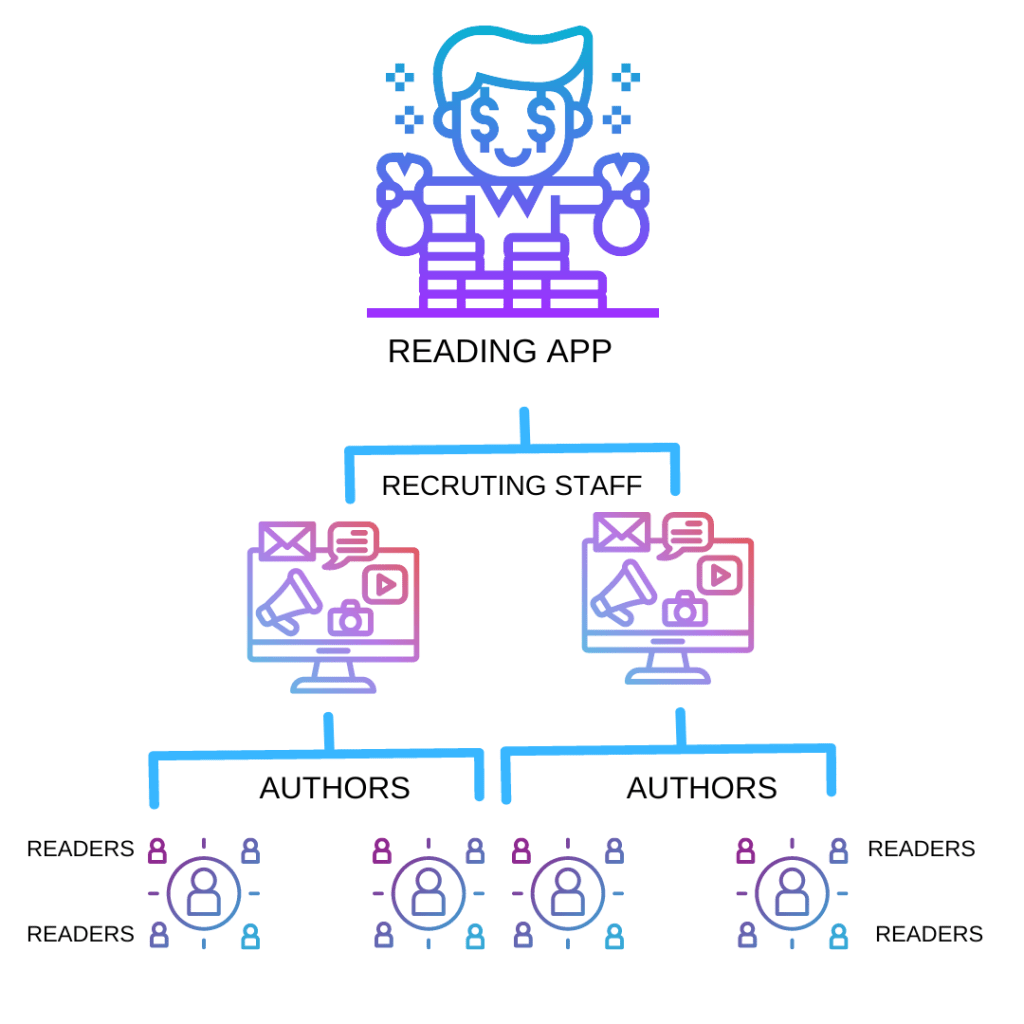
The difference between MLM companies and app writing is simple. Avon sales people are not making the products for the company and are expected to sell it, too. Unlike app writers, who are not only marketing for the app, they are also providing the content/product they sell.
In this pyramid, an assistant editor (AE) is recruited by the apps in-house staff. The AE, aka recruiter, then seeks newbie authors to sign up for their program. This recruiter often has no experience in publishing, so they are left with the challenge to cold message authors, which often becomes intrusive DM spamming on social media.
Just like in MLM, the AE earns for every person they sign up to the company. This doesn’t mean the authors they find are qualified. Most often, they target inexperienced writers, preying on people who lack understanding of the publishing industry. The fact is, newbies are easier to manipulate when it comes down to contract terms. This step in the pyramid, the AE’s are gaining content for the apps library, for the product that will be sold later.
The authors, in most cases, are expected to bring in readers; the paying customer. Just like an Avon sales lady selling lipstick to her clients and friends. Let’s face it, the apps marketing teams do very little marketing of their own content. So, they are using authors as not only product developers but also sales associates.
Then, we come to the readers/consumers who pay for the tokens to read said books. That money is funneled in percentages to every person on the pyramid, including the apps in-house staff, the person at the top gaining the most. In the end, the author is gaining on average of 7-10% of their book. That is if those numbers are even accurate, since often there’s no detailed income reports on many apps. That’s a low percentage considering we are not only doing sales, but writing and providing the company with a product.
These digital products have no overhead at the product level, so there should be a higher percentage rate going to the author. Percentages should be closer to the payout of eBooks though Amazon. Breaking it down, editing, book covers, and book content are provided by the author. Therefore, apps can cut out some of the exaggerated fees they have been deducting, but they don’t.
None of this seems fair, does it? No. Because it’s not. And it defiantly isn’t standard to the wider publishing industries operations.
On average, the traditional trade published author receives 15-30% royalties. This is cut between the author, agent, publisher, and printer. The publisher provides everything up front at no cost to the authors, including marketing, editing, book covers, etc. Their percentage is fair, considering they do a majority of the footwork. Often, if they see worth in your book, they will even provide an up-front advance.
In indie publishing all cost falls on the author, but it can be worked out where there is a quick turnaround in profit. You just have to figure out how to cut cost and know a little marketing. The royalty cut by distribution through Amazon can be from 30% or 70% depending on your publishing choices. A far cry higher than what some apps offer. You may not gain bonuses or advance payment with this option, but your royalties are clearly established out of the gate.
Anyone who has been in the writing app community knows how unfair the treatment of apps to their authors has become. Low pay, unqualified staff, little to no promotion, restrictive contracts that take authors’ rights, and the list goes on. Even when the app starts out good, within a year the goal post is moved, and it turns into a way for the companies to money grub and not pay for a writer’s talents. Most are notorious for changing the rules mid contract. (Note; This is at no fault to the recruiting or editing staff. It falls on the greed of the app owner’s and their poor business model. After all, the AE’s and editors are low on the pyramid, too.)
Sadly, many apps resorted to pushing out additional sister apps that flooded the market and wore the serial reader base thin. Profits for the authors dropped dramatically in the past couple years, but the apps still earn greatly since they own more apps. They tend to fail to inform authors of the additional created apps to avoid paying the extra royalty payments we are due. It’s happened time and time again, and it’s been even more proof that reading apps have been bordering on scam-like behavior, just like the dreaded pyramid schemes.
Often I wonder why organizations like the Authors Guild and Romance Authors of America haven’t taken a stand to demand better treatment for app authors. Especially since most of these writers are newbies who are being taken advantage of. Many authors are taking note and banning together to look out for each other, and spot shady business practices with faulty contract terms, but we can’t do it on our own. Most app writers can’t afford expensive contract lawyers to protect them. A little support from a larger entity would go a long way.
I’m not to saying all reading apps are bad. In fact, there are a few who have proven to be designed for the benefit of the serial writer as well as the company. Radish and Kindle Vella being the top two in that realm that I’ve seen authors most happy with. There are a few others who seem to be fair, but still don’t have the best contract terms.
Here’s the issue I see with apps preying on new authors and using this MLM plan. When you approve books with bad grammar, no proper plot development, and no clear marking plan, the books and the app will fail. More often than not, they fail miserably. In addition, authors with quality work often get overlooked.
Reading apps rely on a few top authors to bring in readers and they cater to them like royalty, forgoing building up other talent they have signed. They rely on hope the books on their platform will earn by the popular few. This takes away their responsibility as publisher for proper marketing. At the end of the day, it’s about money for them, not the books actual marketability. Proof of this is clear when you look at the top recommended authors on the platforms and see the same names being promoted across the board with seldom seeing any change. When looking for the newest book to arrive, it’s imposable because instead of a fair rotating system, many apps will only promote the books they choose. It’s almost like being in high school and hoping to get a chance to sit at the popular kids table.
It’s a failed and broken system that needs to be addressed. Apps need to be held accountable for their poor business practices..
In whole, reading apps are being run like a MLM scheme, and until that changes, very few authors on apps will thrive. It’s up to us to demand change and stand up for our rights.
 Loretta Kendall